What does SEN-friendly soft play mean?
“SEN-friendly” or “SEND-friendly” soft play usually refers to a venue, session or set of facilities that may be more suitable for children with special educational needs, disabilities, sensory sensitivities or additional support needs.
There is no single fixed definition. One venue might use the term because it runs quiet sessions. Another might use it because it has wheelchair access, accessible toilets, reduced-capacity sessions or staff who are more aware of additional needs.
- quieter or relaxed sessions
- reduced capacity
- lower music or no music
- calmer lighting
- fewer announcements
- clearer booking and session times
- a separate toddler or baby area
- a calm space or sensory room
- wheelchair access
- accessible toilets or changing facilities
- clearer information about parking and entrance access
- flexible policies around carers, food, queues or re-entry
The most useful venues are often the ones that explain these details clearly before you arrive.
Why clearer information matters
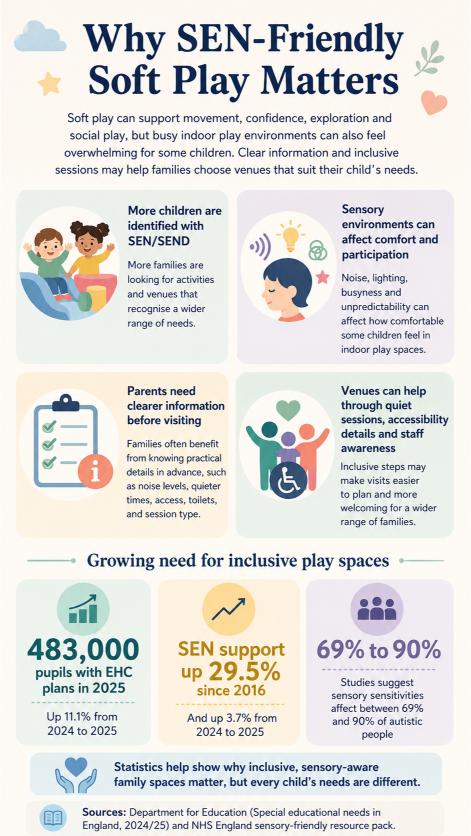
More families are looking for play spaces that feel easier to plan around. This does not mean every child needs the same environment, but it does show why clear, practical venue information matters.
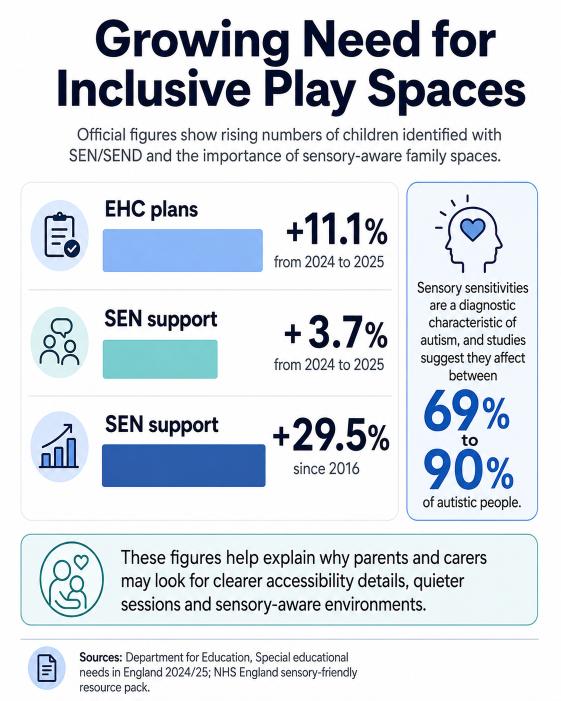
Department for Education data for England shows that the number of pupils with an EHC plan increased by 11.1% between 2024 and 2025 to 483,000. The number of pupils receiving SEN support increased by 3.7% from 2024 to 2025 and by 29.5% since 2016. Department for Education
Sensory needs are also an important part of the picture for many families. NHS England’s sensory-friendly resource pack notes that sensory sensitivities are a diagnostic characteristic of autism, with studies suggesting they affect between 69% and 90% of autistic people. NHS England
Why clearer information matters
National statistics do not show whether a specific venue will suit a specific child, but they do show why clearer, more inclusive information matters for families.
EHC plans
Up 11.1%
Increase from 2024 to 2025
Pupils with EHC plans
483,000
Reported in 2024/25
SEN support
Up 3.7%
Increase from 2024 to 2025
SEN support since 2016
Up 29.5%
Longer-term increase
Sensory sensitivities
69%-90%
Cited range among autistic people
These figures do not tell you whether a particular soft play centre will be right for your child. But they do help explain why parents and carers increasingly need better information about noise, lighting, access, quiet sessions, staff awareness, toilets, parking and calm spaces before deciding where to go.
The 5 things to check before you go
Sensory environment
Soft play centres can be noisy. The sound can bounce around large indoor spaces, especially when there are birthday parties, music, arcade machines or busy cafe areas.
- Is music played in the venue?
- Are there flashing lights or arcade-style machines?
- Are there quiet or relaxed sessions?
- Are numbers reduced during quieter sessions?
- Is there somewhere calm to take a break?
- Are party sessions held at the same time as general admission?
For some children, a normal session may be fine. For others, a quieter weekday morning or specific relaxed session may make a big difference.
Space and layout
The physical layout of a venue can affect how comfortable a child feels. Some children prefer smaller play frames where parents can see them easily. Others need more space to move.
- separate toddler or baby areas
- calm corners or sensory rooms
- clear exits from the play frame
- visibility from the seating area
- whether the venue feels open or crowded
- whether there are narrow tunnels, dark areas or enclosed spaces
- whether photos of the venue are available online
Photos can be especially helpful because they let you prepare your child for what the venue looks like before you arrive.
Access and facilities
Practical details can make or break a visit.
- Is there parking nearby?
- Is the entrance step-free?
- Is the venue wheelchair accessible?
- Are accessible toilets available?
- Are changing facilities available?
- Is there enough seating?
- Is the cafe area easy to move around?
- Is there space for a buggy, wheelchair or mobility aid?
If these details are not listed online, it is worth calling or messaging the venue.
Rules and flexibility
Some venues have strict rules around booking, socks, food, re-entry, time slots and carer admission. These rules are not always obvious until you arrive.
- Do you need to book?
- Are sessions timed?
- Can you leave and re-enter?
- Are grip socks required?
- Can carers attend free or at a reduced price?
- Can you bring safe food if your child has allergies or sensory food needs?
- Are there rules around packed lunches?
- What happens if your child becomes overwhelmed soon after arrival?
A venue does not need to be perfect, but clear rules help parents plan.
Timing
The same venue can feel very different depending on when you visit.
Quieter times may include
- weekday mornings
- term-time sessions
- first session of the day
- dedicated quiet or SEN-friendly sessions
Busier times often include
- weekends
- school holidays
- wet-weather afternoons
- birthday party slots
- after-school periods
If you are unsure, ask the venue: “When is your quietest time to visit?”
What to look for in a SEN-friendly soft play venue
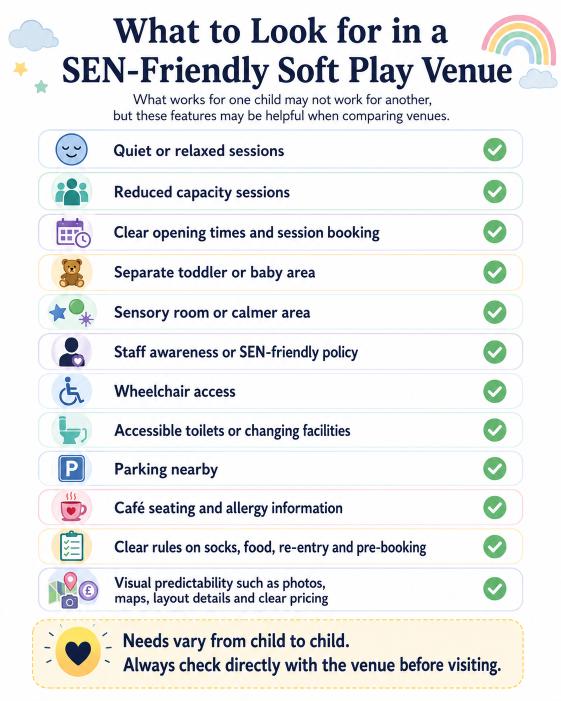
A helpful venue does not have to offer everything. Even one or two thoughtful details can make a visit easier.
- quiet or relaxed sessions
- reduced-capacity sessions
- clear opening times and booking information
- lower music or no music during specific sessions
- separate toddler or baby areas
- a calm area or sensory room
- staff awareness of additional needs
- clear pricing and carer information
- wheelchair access
- accessible toilets or changing facilities
- nearby parking
- allergy information
- cafe seating with enough space
- clear rules around socks, food and re-entry
- up-to-date photos of the play area and seating area
The key is not just whether these features exist. It is whether the venue explains them clearly enough for parents and carers to make an informed decision.
Before you visit: quick parent checklist
Use this checklist before trying a new soft play centre:
- Check whether the venue has quiet, relaxed, SEN-friendly or SEND-friendly sessions.
- Ask when the venue is usually quietest.
- Check whether music, lights or announcements are used.
- Ask whether there is a calm space if your child needs a break.
- Check whether the venue has accessible toilets or changing facilities.
- Check parking and entrance access.
- Ask about carers' entry prices.
- Ask about food and allergy policies.
- Check whether booking is required.
- Look at venue photos if available.
- Check whether birthday parties run during general sessions.
- Confirm opening times directly with the venue before travelling.
This is especially useful if you are visiting somewhere for the first time or travelling further than usual.
Questions to ask before visiting a soft play venue
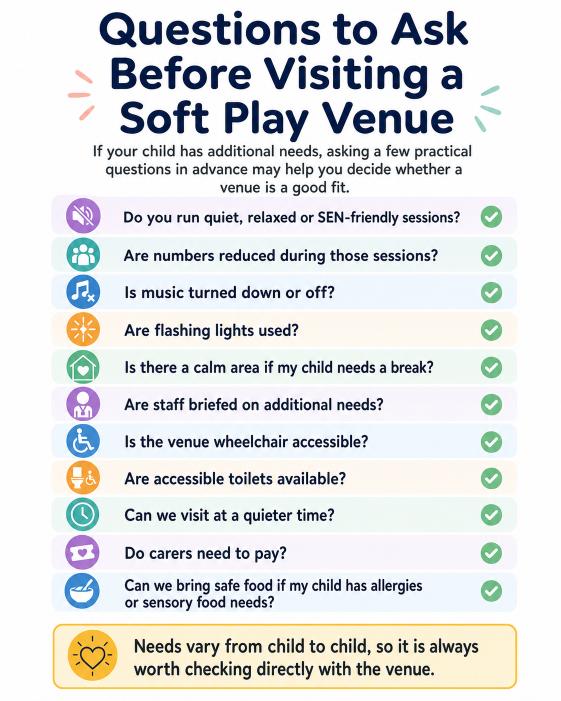
If the venue information is not clear online, it is completely reasonable to call, message or email before visiting.
- Do you run SEN-friendly, SEND-friendly, relaxed or quiet sessions?
- Are those sessions lower capacity?
- Is music turned down or switched off?
- Are flashing lights used?
- Are announcements made over speakers?
- Is there a calm area if my child needs a break?
- Are staff briefed on additional needs?
- Is the venue wheelchair accessible?
- Are accessible toilets available?
- Do carers pay?
- Can we bring safe food if needed?
- Are birthday parties held during normal sessions?
- When is your quietest time to visit?
- Do we need to book in advance?
- What happens if my child becomes overwhelmed shortly after arriving?
You do not need to ask every question every time. Pick the ones that matter most for your child.
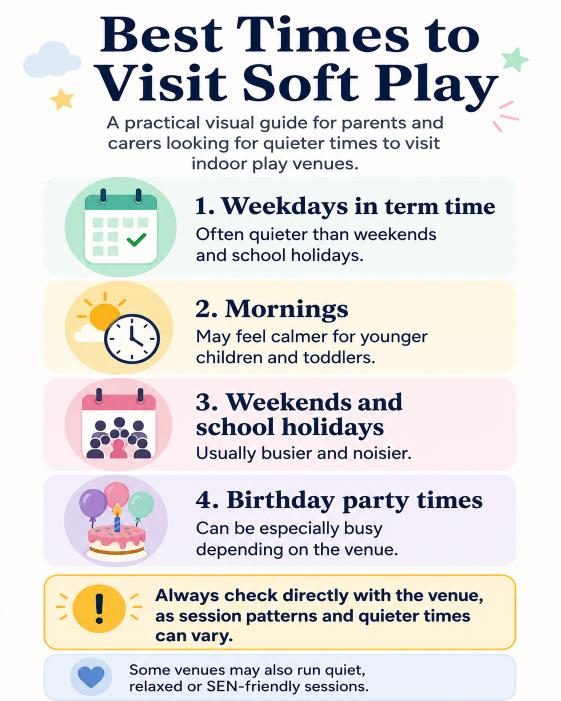
Best times to visit soft play
Weekdays during term time
Term-time weekdays are often quieter than weekends and school holidays. This can be a good option for younger children, home-educating families, children not yet in school, or families with more flexible schedules.
Mornings
Morning sessions can sometimes feel calmer, especially for toddlers and younger children. Venues may also be cleaner and less crowded earlier in the day.
Avoid peak party times if crowds are difficult
Birthday party sessions can make a venue much busier. There may be more children arriving at once, more noise, busier seating areas and more structured announcements.
School holidays can be unpredictable
School holidays can be very busy, especially during wet weather. If you are visiting during holidays, it is worth booking ahead and asking the venue when it expects quieter periods.
Ask the venue directly
“When is usually the quietest time to visit?”
Staff will usually know which sessions are calmer.
How Soft Play Scout can help
Soft Play Scout is designed to help parents and carers compare soft play venues more easily.
- search for soft play near me
- browse soft play venues by town or city
- compare practical details where available
- check features such as parking, cafe, toddler areas, accessibility and SEN-friendly notes
- find nearby towns and alternative venues
- view venue pages before deciding where to go
Venue details can change, so always check directly with the venue before travelling.
Should there be a separate SEN soft play search?
For most families, the most useful approach is not a completely separate search system. It is usually better to search by location first, then filter or compare venues based on the features that matter to your child.
- SEN-friendly notes
- quiet sessions
- wheelchair access
- accessible toilets
- parking
- toddler areas
- calmer spaces
- cafe or allergy information
This avoids creating lots of thin pages with very little information. It also reflects how parents actually make decisions: location matters first, then suitability.
Over time, if there is enough verified information, Soft Play Scout may be able to build more detailed SEN-friendly location guides for major areas. But those pages should only be created where there is enough useful venue data and genuinely helpful local information.
How soft play venues can make information clearer for families
This page is mainly for parents and carers, but it is also useful for venue owners.
If you run a soft play centre, clearer information can help families decide whether your venue is right for them before they arrive.
- whether you run quiet, relaxed, SEN-friendly or SEND-friendly sessions
- the times and dates of those sessions
- whether capacity is reduced
- whether music is turned down or switched off
- whether lights, arcade machines or announcements are used
- whether there is a calm space
- wheelchair access information
- accessible toilet or changing information
- parking and entrance details
- carer pricing
- food and allergy policies
- photos of the play frame, seating area, entrance and toilets
- clear booking rules
If your venue is already listed on Soft Play Scout, you can help families by keeping your details accurate and up to date.
Use this guide as a parent resource
This guide is designed to help parents, carers, nurseries, SEND groups, schools, therapists, family organisations and local resource pages think through what to check before visiting soft play.
You are welcome to share it with families who may find it useful.
The aim is not to label one venue as perfect for every child. It is to help families ask better questions, compare practical information and feel more confident before they visit.
FAQ
What does SEN-friendly soft play mean?
SEN-friendly soft play usually means a venue or session may offer features that are helpful for children with special educational needs or disabilities. This might include quiet sessions, reduced capacity, calmer lighting, accessible toilets, wheelchair access, calm spaces or clearer venue information. The exact meaning varies by venue.
Is SEN-friendly soft play the same as autism-friendly soft play?
Not always. Autism-friendly soft play often focuses on sensory factors such as noise, lighting, crowds and predictability. SEN-friendly or SEND-friendly soft play may cover a wider range of needs, including physical access, communication, sensory needs, learning needs and other additional support needs.
Are quiet soft play sessions usually better for children with sensory needs?
They can be helpful for some children because there may be fewer people, less noise and a calmer atmosphere. But every child is different. Some children enjoy busy environments, while others may find them overwhelming. It is best to check the session details before visiting.
What should I ask before visiting a soft play venue?
Useful questions include whether the venue runs quiet or SEN-friendly sessions, whether music is turned down, whether flashing lights are used, whether there is a calm area, whether staff are aware of additional needs, whether accessible toilets are available and when the venue is usually quietest.
How can I find SEN-friendly soft play near me?
You can start by searching for soft play near you, then look for venues with SEN-friendly notes, quiet sessions, accessibility details, parking, toddler areas, calm spaces or other features that matter to your child. Always check directly with the venue before travelling.
Should I call the venue before visiting?
Yes, if you are unsure. Calling or messaging the venue can help you check quiet times, access, carer policies, food rules, booking requirements and whether the session is likely to suit your child.
Can soft play be overwhelming for some children?
Yes. Soft play centres can be busy, noisy and visually stimulating. Some children enjoy that, while others may find it difficult. Quieter sessions, calm spaces, clear routines and better information can make visits easier for some families.
What time is soft play usually quietest?
It depends on the venue, but weekday mornings during term time are often quieter than weekends, school holidays and birthday party slots. The best approach is to ask the venue when it is usually calmest.